Your Inbox Was Never Meant to Store Receipts
If you've ever searched endlessly for a receipt buried in your inbox or text messages, you're not alone. Discover why today's digital receipts still fall short, and what's coming next.
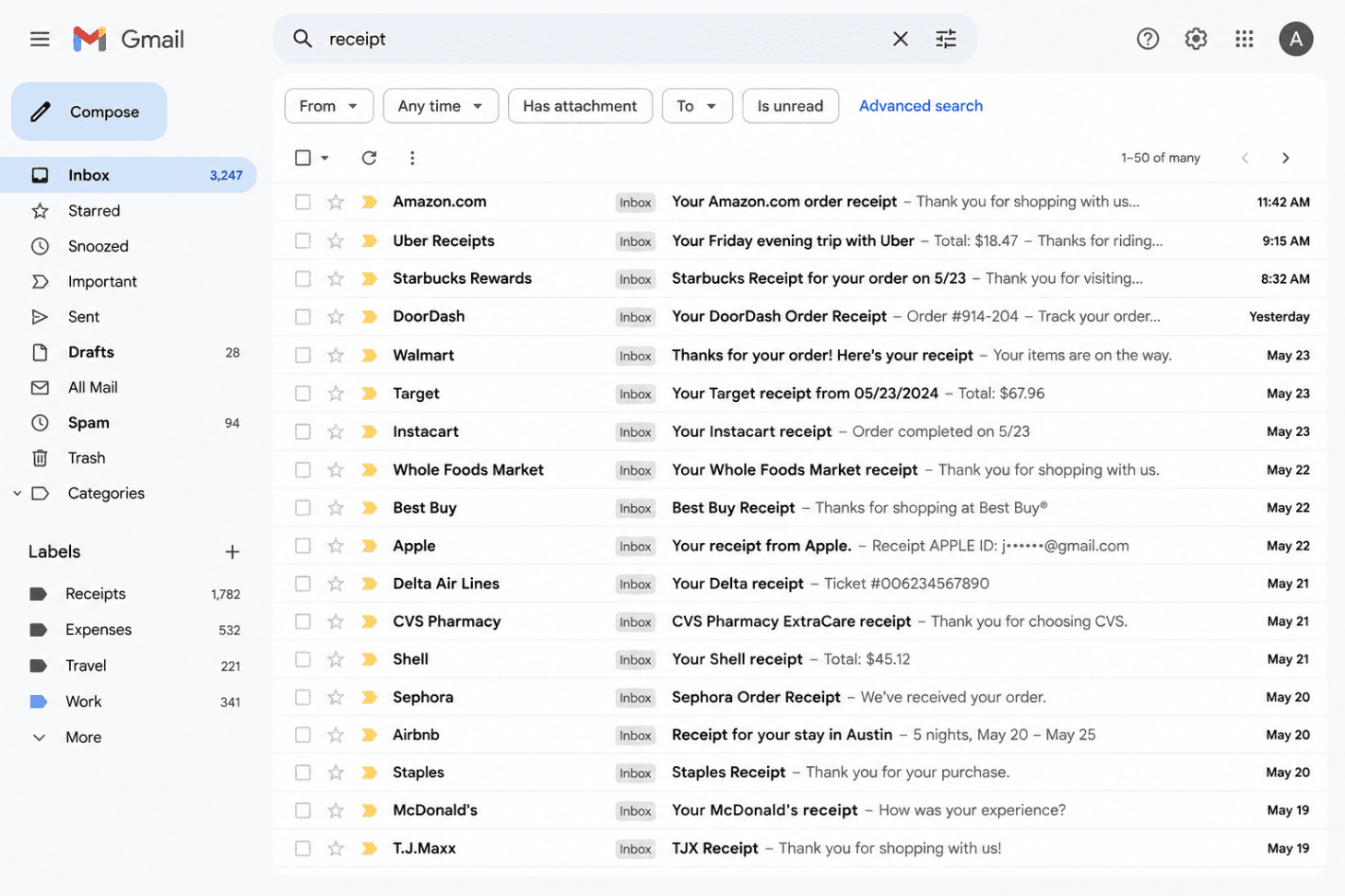
Why Email and Text Receipts Aren't the Solution We Think They Are
For years, email and text receipts have been marketed as the modern alternative to paper receipts. They save paper, they're harder to lose, and they seem like the obvious next step in the checkout experience.
But if you've ever spent fifteen minutes digging through your inbox looking for a receipt from six months ago, you know they aren't nearly as convenient as they sound.
Instead of solving the receipt problem, email and text receipts have simply moved it from your wallet to your inbox.
Email Receipts Turn Your Inbox Into a Filing Cabinet
Think about everything that already lands in your inbox every day.
There are work emails, newsletters, shipping confirmations, calendar invites, password resets, promotional offers, and messages from friends and family. Now imagine adding every receipt from every purchase you make on top of all of that.
At first, it doesn't seem like a big deal. But after months—or even years—those receipts become incredibly difficult to find.
Every retailer formats emails differently. Some send receipts from their store name, while others use payment processors or generic "no-reply" email addresses. Some include the word "receipt" in the subject line, while others don't mention it at all.
When you finally need a receipt for a return, warranty claim, or expense report, finding it often becomes a guessing game.
Text Receipts Can Be Even Harder to Manage
Text receipts feel more convenient because they're delivered instantly, but they come with many of the same problems.
Unlike a dedicated receipt manager, your text messages weren't designed to organize financial records. Receipts quickly become buried between conversations with friends, appointment reminders, verification codes, and delivery notifications.
Months later, trying to remember which phone number texted you a receipt—or when you made the purchase—can be just as frustrating as searching through an overflowing inbox.
And if you delete old messages or switch devices without transferring everything, those receipts may disappear altogether.
They're Not Built for Reimbursements
Anyone who's ever submitted an expense report knows that having a receipt isn't always enough.
Many email and text receipts don't include all of the information businesses or accounting departments require. Depending on the retailer, important details like itemized purchases, tax information, the merchant's address, or payment details may be missing.
That often means contacting the business to request another copy or scrambling to find additional documentation before reimbursement deadlines.
A receipt should make reimbursement easier—not create more work.
Sharing Receipts Shouldn't Require Extra Steps
There are plenty of situations where you need to send a receipt to someone else, whether it's your employer, accountant, spouse, or a client.
With email receipts, that usually means locating the email, downloading the attachment, saving the file, and then attaching it to another email before you can send it.
Text receipts often require taking screenshots, cropping images, or sending multiple messages just to share a single purchase.
For something as common as a receipt, the process is surprisingly inefficient.
The Format Changed, But the Work Didn't
Paper receipts required people to keep track of tiny slips of paper.
Email and text receipts replaced the paper, but they didn't eliminate the work.
You're still responsible for remembering where receipts are stored, searching for them when you need them, organizing them into folders, and making sure they don't disappear over time.
The receipt became digital, but the experience never truly evolved.
What Digital Receipts Should Actually Look Like
The best receipt is one you never have to think about.
Imagine making a purchase and having your receipt automatically appear in one place where it's organized, searchable, and ready whenever you need it.
Need to submit an expense report? Open the app and share it.
Need to find a purchase from last year? Search by merchant, date, or amount.
No inbox searches. No scrolling through text messages. No downloading attachments.
Just your receipts, exactly where you'd expect them to be.
The Future Goes Beyond Email
Email and text receipts were an important step toward reducing paper, but they were never the final destination.
The future of receipts isn't another inbox notification or another text message. It's a system where receipts are automatically delivered, securely stored, and instantly accessible whenever you need them.
How PapeX Is Building That Future
At PapeX, we're rethinking what digital receipts should look like.
Today, users can receive receipts by providing their PapeX email at checkout or by scanning paper receipts into the app, where they're automatically organized, searchable, and easy to share.
We're also building technology that will automatically deliver receipts to the PapeX app when you tap your payment card at checkout—eliminating the need for paper receipts, overflowing inboxes, and endless text message threads.
Because receipts shouldn't be another thing you have to manage. They should simply be there when you need them.
Ready to simplify your receipts? Join our waitlist at https://papex.app/waitlist and be among the first to experience the future of digital receipts.